


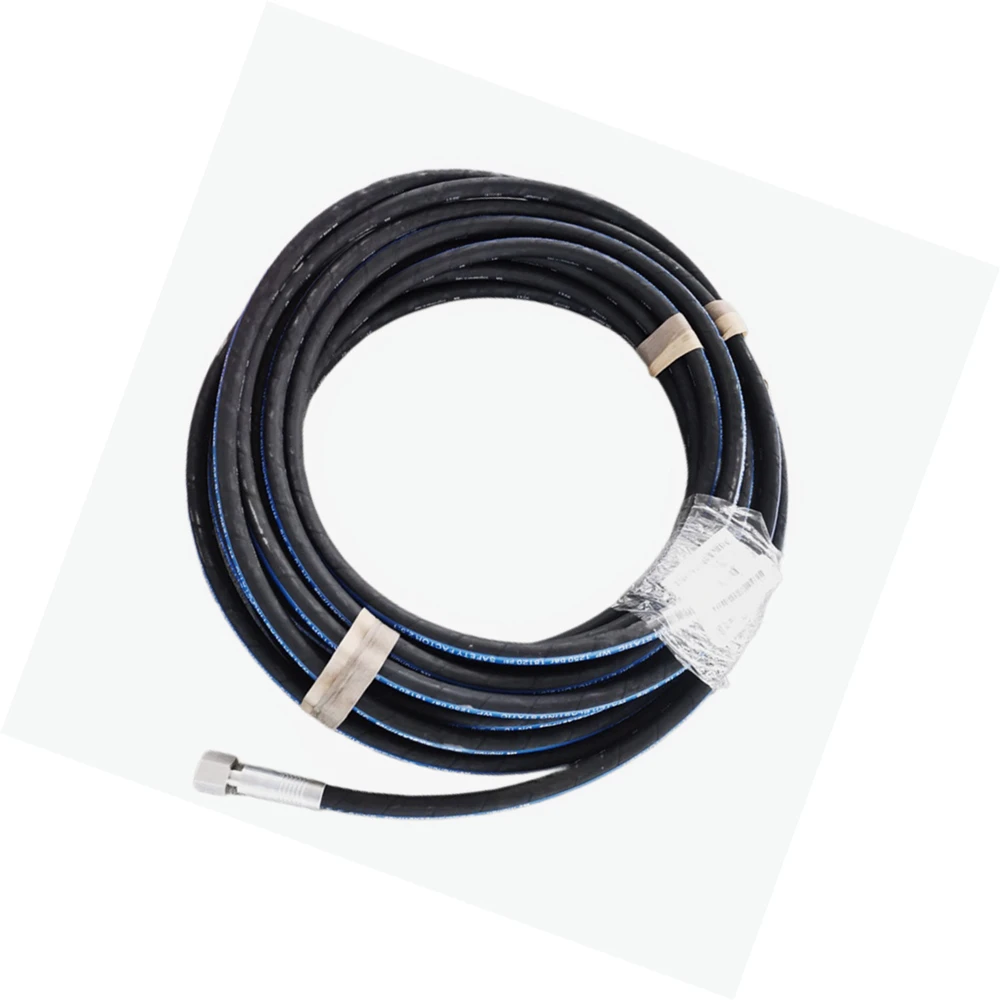
The High Pressure Water Jetting Hose delivers reliable drainability for internal residual water under normal conditions. Most standard models can discharge accumulated water efficiently, with drainage difficulty determined primarily by working conditions and hose service status. Three core factors affect drainage performance: hose structure, dimensional specifications, and operating conditions. Structurally, standard High Pressure Water Jetting Hoses adopt seamless, smooth inner wall construction without irregular surfaces or joint dead zones, minimizing flow resistance and preventing large-scale water retention. In addition, straight-through end connectors feature identical aperture sizes matching the pipe body without diameter reduction or flow blockage, ensuring unobstructed passages for residual water discharge.
Short-length, standard-diameter High Pressure Water Jetting Hoses are exceptionally easy to drain during daily operation. After use, operators simply shut down the water supply unit, disconnect the hose inlet, and hold down the spray gun trigger to release system pressure. Residual internal pressure actively expels most accumulated water from the pipeline. The hose should then be fully straightened to eliminate bends and coils, tilted alternately by elevating both ends, and shaken gently. This process removes over 95 percent of internal water, leaving only negligible moisture residue within connector thread gaps and minor wall textures, which does not affect routine hose storage and preservation.
Certain special conditions increase drainage difficulty moderately. First, ultra-long, large-diameter industrial-grade hoses possess larger internal volumes and hold more residual water, requiring longer drainage time and tending to form low-lying water pockets due to extended pipe spans. Second, long-term operation leads to inner wall aging and scaling, increasing surface roughness and allowing minor water adhesion that cannot be fully eliminated through conventional draining. Third, repeated bending and twisting after use create stagnant water dead corners that obstruct complete water outflow.
Ambient temperature also exerts a significant influence on drainage effectiveness. Water drains smoothly under room-temperature conditions. However, in winter environments at 0℃ or below, residual water inside the High Pressure Water Jetting Hose easily freezes. Frozen water cannot drain naturally, and forced hose pulling may crack the pipe wall and damage the internal steel wire reinforcement layer. Accordingly, winter drainage requires relocating the hose to a warm environment to fully melt internal ice before performing tilting and shaking drainage procedures.
A standardized operational procedure ensures complete drainage: first, power off the equipment, cut off the water supply, and release residual pressure to drain bulk accumulated water; second, fully straighten the hose and perform segmented elevation and draining to eliminate low-lying stagnant zones; third, apply low-pressure compressed air via an air compressor to purge residual water vapor and achieve full internal drying. Overall, the High Pressure Water Jetting Hose achieves effective water drainage without complex professional equipment. Standard operation and proper environmental awareness effectively prevent mold growth, freeze cracking, and accelerated material aging caused by residual water accumulation.