


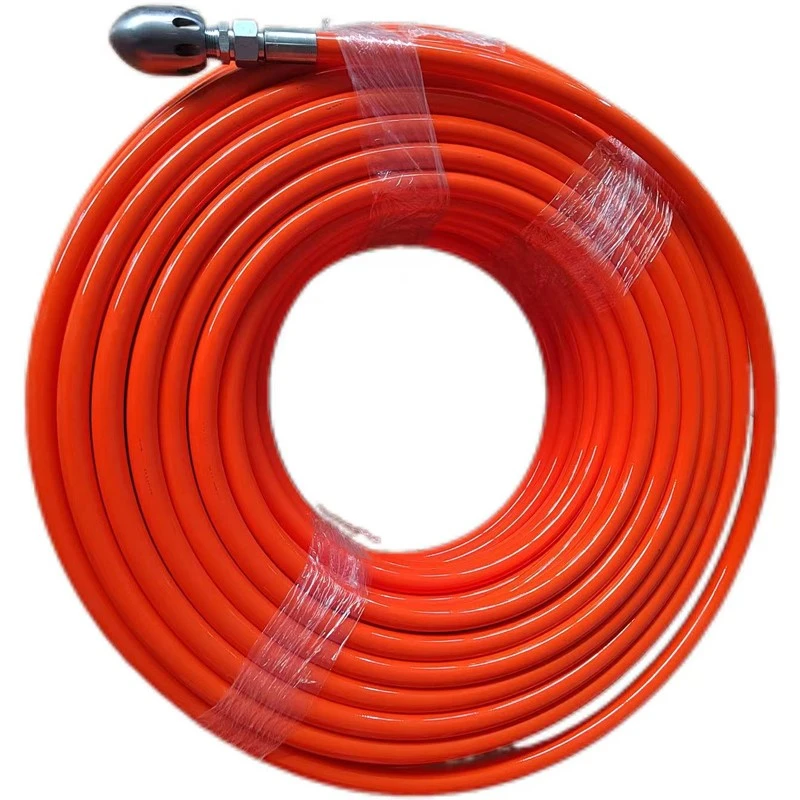
The sewer flushing hose is a reusable consumable rather than a disposable product, and this core operating characteristic applies to high-pressure sewer flushing hoses and flexible dredging hoses used in municipal dredging, commercial cleaning and household applications. Sewer flushing hoses manufactured by reputable qualified manufacturers can withstand multiple reuses, with service lives ranging from several months to several years. Actual service life depends on material composition, usage frequency, operating pressure and storage conditions. Three primary material types of sewer flushing hoses dominate the market, each with distinct reuse cycles and application specifications. Single-layer PVC flexible hoses deliver the best cost performance and suit low-frequency household use, normally supporting dozens of reuse cycles. Polyurethane high-pressure hoses offer superior toughness and wear resistance alongside high-pressure tolerance; they serve as the primary hose type for commercial dredging equipment and support long-term frequent reuse. Double-layer reinforced rubber flushing hoses provide maximum pressure resistance, matching large municipal dredging machinery and offering the longest service life for repeated use.
The hose's reusability stems from its inherent resistance to sewage corrosion and hydrodynamic scouring. Under normal operating conditions, sewage, sludge, oil residues and fine sand particles within sewers will not inflict structural damage on an intact hose inner wall. After each dredging job, only minor dirt remains inside the hose. A simple rinse with clean water followed by air drying restores the hose to good working condition and fully prepares it for the next operation. Unlike disposable plastic pipe fittings, sewer flushing hoses feature production processes optimized for dredging work, with uniform wall thickness and stable structure, capable of enduring repeated high-pressure water flow, stretching and mild bending.
That said, clear scrapping criteria govern repeated use; hoses cannot be reused indefinitely. First concerning physical damage: any hose exhibiting cracks, pinholes, bulges, localized thinning or water seepage must be replaced immediately. Damaged areas expand rapidly under high-pressure water feed, which can easily trigger pipe rupture, water ejection hazards and equipment malfunctions. Second concerning aging degradation: after prolonged heavy use, hose inner walls may develop coating delamination, matte surface wear and heavy scale buildup. These issues not only reduce water pressure and weaken dredging effectiveness but also release loose debris that can clog sewer lines. In addition, worn, loose or failed sealed hose connections cannot maintain stable coupling with dredging equipment and require replacement.
Basic maintenance practices extend the reuse life of sewer flushing hoses. After every use, thoroughly flush oil residues and sludge trapped inside the hose with clean water to stop impurities from adhering to the pipe wall long-term, which would cause corrosion and mold growth. Clean the hose and allow it to air-dry naturally to avoid residual water accelerating aging. During storage, protect the pipe wall from scratches by sharp objects and keep the hose away from strong acid and strong alkaline chemicals. Operate strictly within the hose's rated pressure rating and prohibit overpressure operation to minimize structural degradation of the pipe wall. With consistent routine maintenance and regular inspection for damage and aging, ordinary household sewer flushing hoses can operate reliably for 1 to 3 years, and commercial hoses for heavy-duty use can last more than half a year, substantially cutting operational costs.