

Yo, I'm a supplier of teflon hoses, and today I wanna chat about whether teflon hoses are suitable for high - speed fluid transfer. Let's dig in!
First off, let's understand what teflon hoses are. Teflon, or PTFE (Polytetrafluoroethylene), is a super - versatile material. It's well - known for its non - stick properties, and it's used in all sorts of applications, from cookware to industrial equipment. When it comes to hoses, teflon offers some pretty amazing features.
One of the key factors for high - speed fluid transfer is the hose's ability to handle pressure. Teflon hoses are great in this regard. They have excellent pressure resistance. The smooth interior surface of teflon reduces the friction that the fluid experiences as it moves through the hose. With less friction, the fluid can flow more freely at high speeds without causing a significant build - up of pressure. This means that you can transfer fluids quickly without worrying about the hose bursting due to excessive pressure.
Another important aspect is chemical compatibility. Different fluids have different chemical properties. Some are acidic, some are basic, and some are organic solvents. Teflon hoses are highly resistant to a wide range of chemicals. Whether you're dealing with aggressive acids like sulfuric acid or strong alkalis, teflon hoses can handle them without degradation. This is crucial for high - speed fluid transfer because when the fluid is flowing rapidly, any chemical reaction between the hose and the fluid can lead to damage to the hose over time, which could cause leaks and disrupt the transfer process.
Now, let's talk about temperature resistance. High - speed fluid transfer can sometimes generate heat due to the friction of the fluid against the hose walls. Teflon hoses can withstand a wide range of temperatures, from extremely cold to very high temperatures. They can operate in temperatures as low as - 200°C and as high as 260°C. This means that even if the fluid transfer generates heat, the teflon hose won't be damaged, and its performance won't be affected.
Flexibility is also a big plus. In many industrial settings, hoses need to be routed around various equipment and obstacles. Teflon hoses are flexible, which allows for easy installation and routing. They can be bent and shaped according to the requirements of the system without kinking or losing their structural integrity. This flexibility ensures that the fluid can flow smoothly through the hose, even in complex setups, which is essential for high - speed fluid transfer.
However, it's not all sunshine and rainbows. There are a few things to consider before using teflon hoses for high - speed fluid transfer.
Cost is one factor. Teflon hoses are generally more expensive than other types of hoses. The production process of teflon is complex, and the raw materials are also costly. So, if you're on a tight budget, you might need to think twice.
Wear and tear can also be an issue. Although teflon is a durable material, in some high - speed applications where the fluid contains abrasive particles, the inner surface of the hose can gradually wear out. This can affect the flow rate and the overall performance of the hose over time.
Let's take a look at some of the specific types of teflon hoses that are commonly used in high - speed fluid transfer.
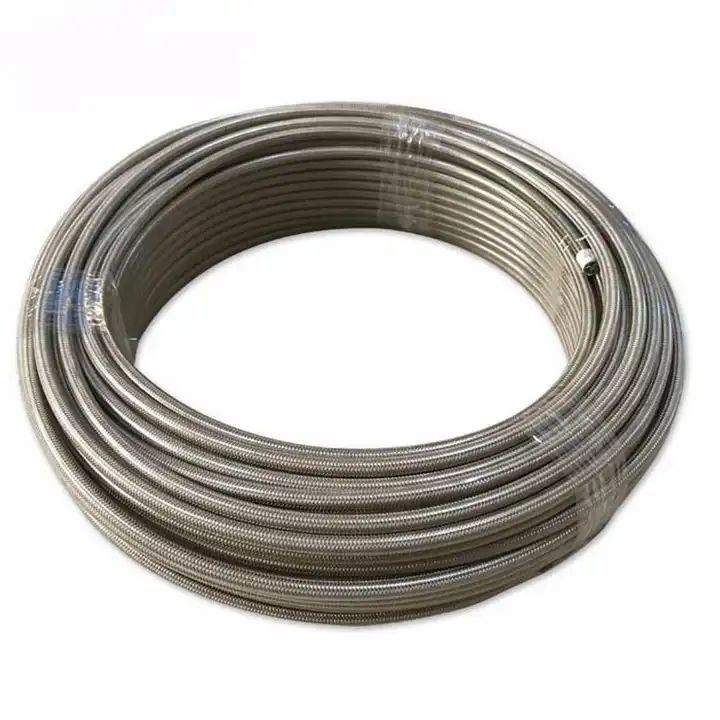

The PTFE Braided Hose is a popular choice. The braided outer layer provides additional strength and support to the teflon inner tube. This makes the hose more resistant to pressure and kinking. The braiding also helps to protect the teflon from external damage, such as abrasion from surrounding objects. It's a great option for transferring fluids at high speeds in industrial environments.
The PTFE Flexible Hose is another excellent option. As the name suggests, it's highly flexible, which is ideal for applications where the hose needs to be moved around or routed in tight spaces. Its flexibility doesn't compromise its ability to handle high - speed fluid transfer. The smooth teflon interior ensures that the fluid can flow freely with minimal resistance.
The SAE 100 R14 Teflonning Hose is designed specifically for high - pressure and high - speed fluid transfer in hydraulic systems. It meets the standards set by the Society of Automotive Engineers (SAE), which means it has been tested and proven to perform well under demanding conditions. This hose is often used in automotive and industrial hydraulic applications where precise and rapid fluid transfer is required.
In conclusion, teflon hoses are generally suitable for high - speed fluid transfer. Their pressure resistance, chemical compatibility, temperature resistance, and flexibility make them a great choice for many industrial applications. However, you need to consider the cost and potential wear and tear factors depending on your specific requirements.
If you're interested in sourcing teflon hoses for your high - speed fluid transfer needs, don't hesitate to reach out. We're here to help you find the best solution for your application. Whether it's a small - scale project or a large - scale industrial operation, we've got the knowledge and the products to meet your needs. Let's have a chat and see how we can work together to make your fluid transfer process more efficient and reliable.
References:
- Chemical Properties of PTFE - Industrial Chemistry Handbook
- Pressure and Flow Characteristics in PTFE Hoses - Fluid Dynamics Studies
- Standards and Specifications for High - Performance Hoses - SAE Publications